Author: Site Editor Publish Time: 2026-01-01 Origin: Site
In autoclaved aerated concrete (AAC) production, it's tempting to blame quality issues on the cutter, the autoclave, or "operator error." But in most plants, the real root cause sits upstream. AAC Block Raw Materials determine whether blocks ship as premium, straight-edged products - or end up as scrap, rework, and customer complaints.
When the slurry is inconsistent, defects appear quickly: chipped corners, soft edges, density swings, and green cakes that warp after cutting. Once the pore structure forms incorrectly, no amount of fine-tuning later in the line can truly undo it. AAC is not a simple concrete mix. It's a controlled chemical and physical process where tiny deviations in fineness, moisture, or dosing can change how the cake rises, sets, cuts, and cures.

That's why QUNFENG treats AAC Block Raw Materials as a complete chain, not a purchasing checklist. Crushing and grinding, batching accuracy, mixing stability, and curing control must work together. When they match, quality becomes repeatable instead of "good on some shifts."
AAC performance comes from an engineered pore structure. Each ingredient has a specific job, and when one moves out of tolerance, the whole system feels it.
n Siliceous materials: fly ash, sand, silica flour
Siliceous materials provide the backbone of the block. After proper grinding, they react with lime under autoclave conditions to form strength-bearing phases. If sand is too coarse or poorly graded, the pore walls can become weak and uneven. If fly ash varies from load to load, you may see strength fluctuations, unstable rising, or inconsistent density. This is why fineness and consistency matter as much as "source."
n Calcareous materials: lime and cement
Lime and cement drive the chemistry that supports early structure. Lime reactivity and fineness influence how quickly the green cake gains the strength needed for safe cutting. If early strength is low, cakes can tear, slump, or distort during handling. Cement quality also affects stability and final performance, especially when raw material variability is already high.
n Aluminum powder or paste
Aluminum is the gas-forming trigger. In an alkaline slurry, it releases hydrogen that creates millions of pores. Because its effect is amplified, aluminum dosing demands tight control. Small errors can shift density, change pore distribution, and produce hidden weak zones. When corners break easily or thermal performance becomes inconsistent, aluminum control is often part of the story - even when it's not the first thing people check.
n Gypsum
Gypsum helps regulate reaction timing and supports dimensional stability. Poor gypsum control can lead to cakes that expand too fast, shrink unevenly, or warp after cutting. The symptom may look like a cutting problem, but the cause is frequently a reaction-balance problem.
n Water
Water is not a "filler." Its temperature, stability, and impurity level affect slurry flow, reaction speed, and foaming behavior. If water conditions fluctuate, pore formation can become unstable, and surface defects may increase. In AAC, water consistency is process control.
On paper, an AAC recipe looks fixed. In reality, AAC Block Raw Materials change constantly.
Fly ash from different sources may vary in fineness and unburned carbon. Sand can shift with seasonal moisture or clay contamination. Lime reactivity may drift between suppliers - or even between batches from the same supplier. The risk isn't just variation; it's the speed of variation. A material change can hit faster than operators can react, especially during high output, shift handovers, or when troubleshooting is already underway.
A practical approach is to define acceptance windows and monitor the variables that move most often, such as:
ü Particle size distribution (sand, fly ash, lime)
ü Moisture content (especially for sand storage and dosing accuracy)
ü Basic chemical tolerance limits (to control impurities and instability)
QUNFENG's "system view" focuses on preventing fluctuations from reaching the mixer in the first place: stable storage, controlled conveying, accurate weighing, blending rules, and traceable batch records. When upstream control improves, the plant stops relying on emergency adjustments and starts running predictably.

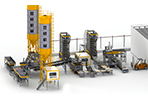
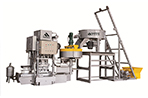
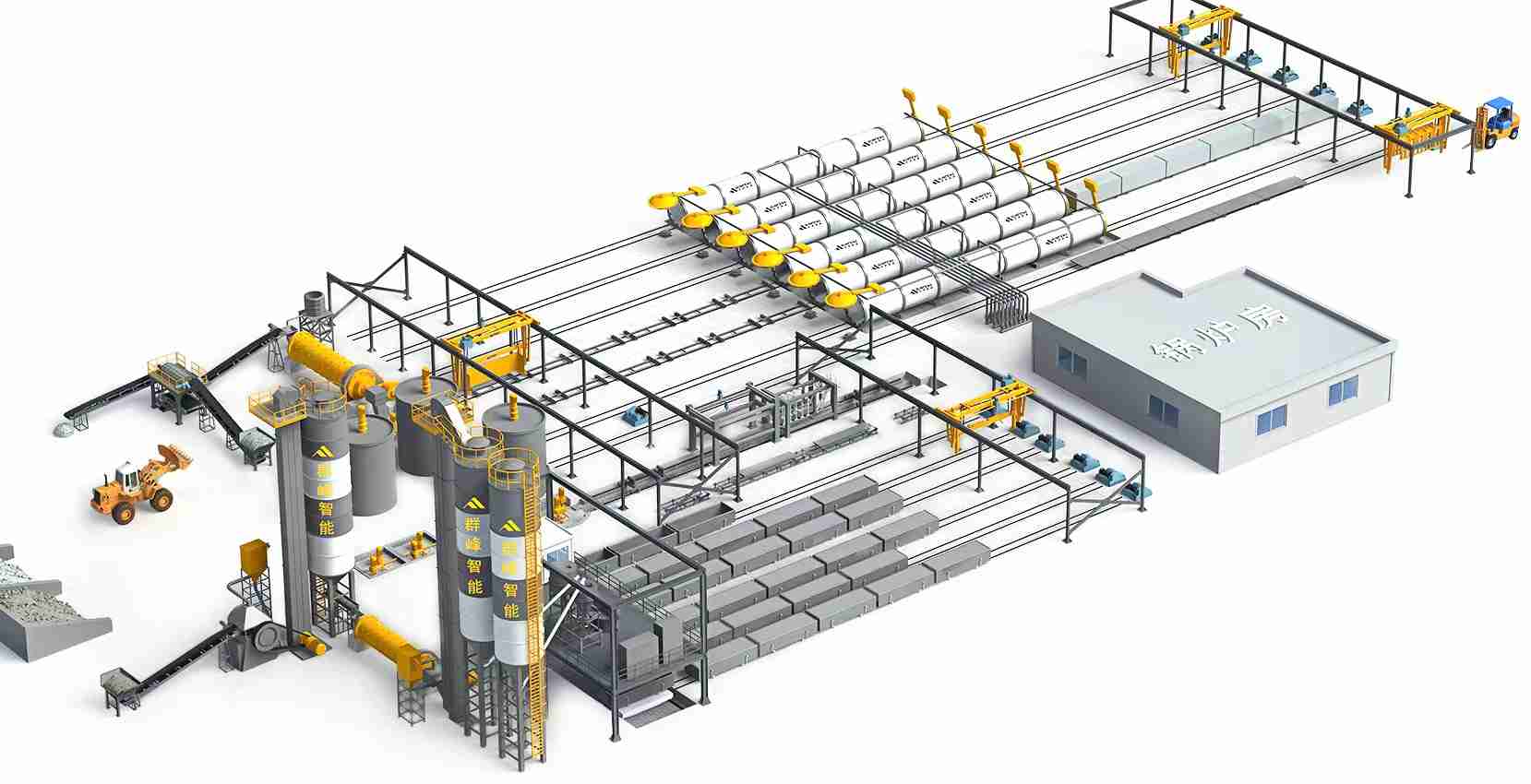
(AAC Block Production Line)
Even high-quality AAC Block Raw Materials can underperform if preparation is weak. This stage is where many plants either build stability - or create defects that show up later.
Siliceous materials often require crushing and grinding to reach target fineness. Depending on process design, grinding may be dry (powder) or wet (slurry). Lime commonly arrives in lumps and needs crushing, then grinding and protected storage. Gypsum may be processed to support uniform mixing and reaction control.
Modern AAC lines automate most movement and dosing because AAC is sensitive to small shifts. Just a few kilograms difference in aluminum or water can change:
ü Density and pore stability
ü Cutting behavior and edge integrity
ü Final consistency across pallets
QUNFENG emphasizes integrated handling practices such as enclosed conveying to reduce dust and loss, accurate weighing with batch traceability, and sensible recycling strategies (when applicable) to reduce waste and stabilize material use. When preparation is disciplined, troubleshooting becomes faster because the process is no longer "guessing in the dark."
• AAC block properties are not created in the autoclave alone; they are built from the raw material system.
• Density stability depends on consistent foaming and slurry viscosity. When AAC Block Raw Materials drift, pore size becomes uneven and weak zones appear.
• Strength and durability depend heavily on fineness and reactivity. Poor preparation can lead to incomplete reaction products and lower strength.
• Thermal insulation relies on uniform, fine pores. Larger or connected pores can reduce insulation performance.
• Dimensional accuracy starts in the green cake. If expansion is uneven or early strength is unstable, cutting precision suffers - and autoclaving will not "fix" warped geometry.
If your plant is seeing density swings, edge damage, or low strength, the fastest improvement often comes from tightening AAC Block Raw Materials control before changing machine settings.
n Sustainability and Smarter Material Choices
AAC can support sustainability goals by using industrial by-products such as fly ash (where quality and availability allow). Optimized formulations may also reduce binder consumption while still meeting strength and density targets - often lowering CO₂ impact per cubic meter of product. Combined with an efficient production line, better material efficiency can cut operating costs while strengthening a plant's position in green building supply chains.

n A Practical Selection Strategy for Different Markets
There is no single "best" AAC recipe. In practice, the "best" solution is the one that reflects what your local supply chain can deliver and still keeps the mix under control. Start by mapping the AAC Block Raw Materials available in your area and validating them through careful testing rather than assumptions. Focus on cost per usable ton of product, not only on price per ton of raw material - unstable inputs often translate into more breakage, line stops, and lost shifts. Your silos, grinding equipment, and dosing systems should be sized and configured to cushion typical variability. QUNFENG assists producers by screening and comparing different AAC Block Raw Materials, defining preparation routes that fit local conditions, and integrating handling and batching systems that safeguard consistent output despite fluctuating supply.
AAC rewards control. Machinery matters, but AAC Block Raw Materials set the quality ceiling. Consistent siliceous input, reactive lime, accurate aluminum dosing, balanced gypsum, and stable water conditions determine whether blocks meet strength, density, and dimensional targets day after day.
QUNFENG's approach is straightforward: treat materials, preparation, batching, and curing as one connected system. When inputs are stable, production scales smoothly. And when quality is repeatable, growth becomes a plan - not a gamble.
CTA: If you're planning a new AAC project or upgrading an existing line, talk with QUNFENG about reviewing your AAC Block Raw Materials and building a stable material-to-autoclave solution. Stable inputs are often the shortest path to dependable quality and scalable output.