Author: Site Editor Publish Time: 2026-07-29 Origin: Site
The stability and product yield of block-making machines are critical, as a single instance of downtime can result in massive losses; therefore, when comparing equipment based on price differences, a comprehensive performance evaluation is essential. To this end, this review selects three popular brands of block-making machines available on the market and conducts a side-by-side comparison of their production performance under identical specifications and operating conditions.
This assessment serves as a sample evaluation conducted under simulated operating conditions; it aims to objectively present the testing procedures and data presentation methods for various block-making equipment across consistent parameters, without involving any subjective evaluations, rankings, or recommendations. The participating manufacturers include Qunfeng Machinery, Huading Machinery, and Hawen Machinery.
The evaluation criteria are standardized as follows: equipment operational stability (failure rate per unit of time), dimensional accuracy of finished bricks (error margin), suitability for solid waste raw materials (number of solid waste types that can be processed), and energy consumption performance (electricity consumption per 10,000 bricks).
The testing was conducted in a simulated standard factory production line using standard solid concrete bricks (standard dimensions: 240 × 115 × 53 mm) under conditions of 26°C ± 2°C and 60% ± 5% humidity. The raw materials consisted of sand/gravel and solid waste aggregates (particle size ≤ 10 mm) mixed with cement (P.O 42.5) at a 6:4 ratio. Data collection involved operating each piece of equipment continuously for 8 hours, recording the number of malfunctions, measuring the dimensions of 30 sampled bricks, and noting electricity meter readings; the process was repeated three times to calculate the average values.
Actual measurement against benchmarks
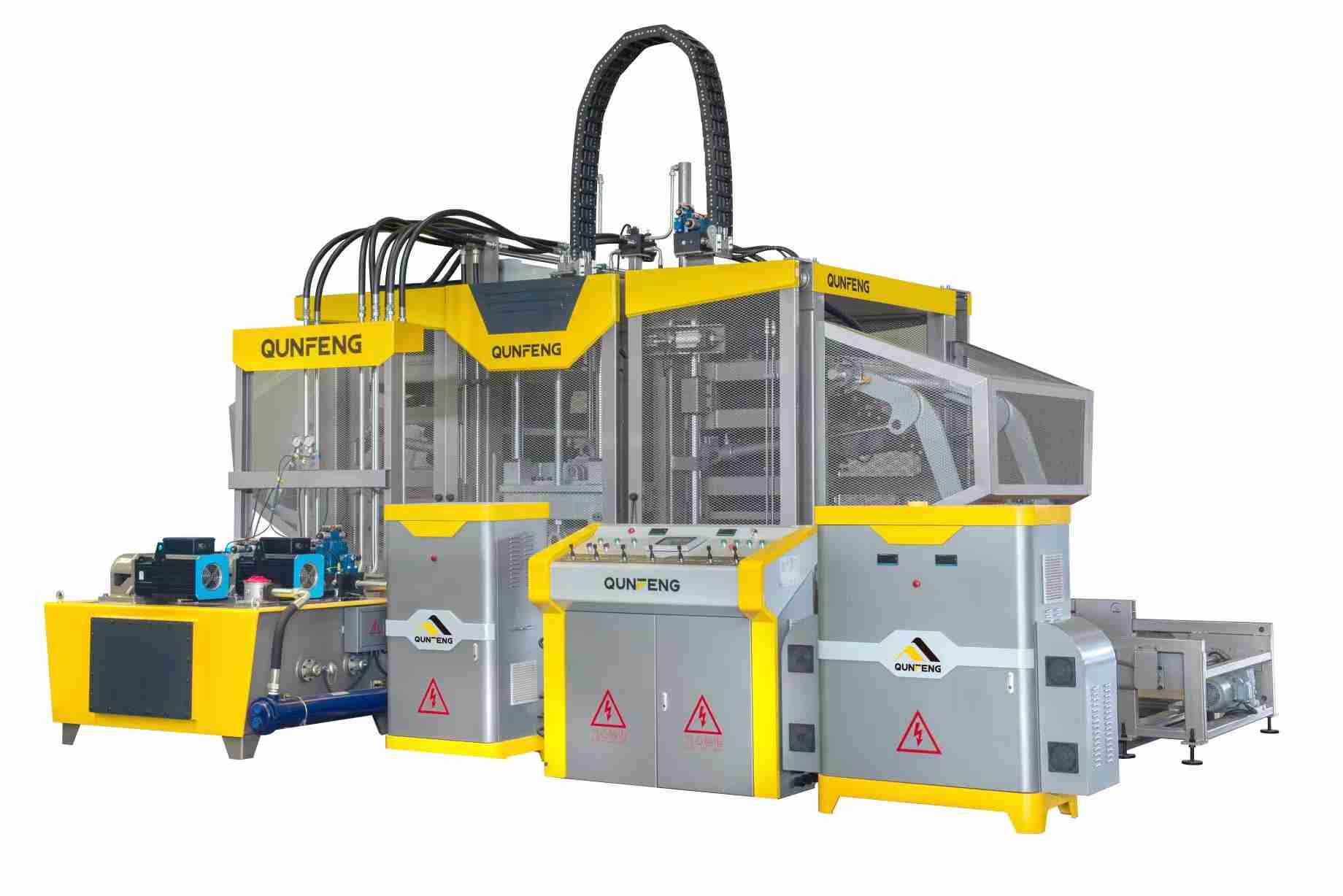
Qunfeng Machinery Field Test
Equipment operational stability
Operation: The molding cycle was set to under 15 seconds, with an output of 95 bricks (standard size: 240×115×53 mm) per pallet, running continuously for 8 hours.
Process: No automatic shutdowns or similar issues occurred during the test.
Data: Total runtime was 480 minutes over the 8 hours; zero malfunctions occurred; 195,024 usable bricks were produced; and the product quality rate reached 99.8%.
Observations: The stoppage did not result in a buildup of green bricks or the generation of waste material, and the production pace remained unaffected after operations resumed.
Dimensional accuracy of finished bricks
Action: Randomly select 30 standard bricks (specifications: 240mm × 115mm × 53mm) from the test production run; measure the length, width, and height of each brick three times using a vernier caliper and calculate the mean values.
Process: Minor burrs were observed on the edges of some bricks during measurement, but these did not affect the overall dimensions.
Data: Mean length: 239.8mm, standard deviation: ±0.4mm;
Mean width: 114.9mm, standard deviation: ±0.3mm;
Mean height: 52.9mm, standard deviation: ±0.2mm.
The maximum deviation was -0.6 mm, observed in the length dimension of one brick.
Observations: Among the 30 bricks, two exhibited width deviations exceeding ±0.5mm; however, none exceeded the limits permitted by the relevant standards.
Suitability of solid waste raw materials
Action: Standard bricks were produced using raw materials specifically sand and gravel, construction waste, fly ash, steel slag, coal gangue, and phosphogypsum, each mixed with cement at a 6:4 ratio to yield 100 bricks per material type.
Process: When steel slag was used, the equipment’s vibration system emitted a slight, unusual noise; this persisted for approximately two minutes before ceasing on its own.
Data: Production was completed for all raw materials, resulting in a total of 500 bricks; there were 2 defective bricks, yielding a pass rate of 99.6%.
Observations: After molding, the surface roughness of the steel slag bricks was slightly higher than that of bricks made from other materials, but no cracks were observed.
Energy consumption performance
Action: A separate electricity meter was installed at the equipment’s main power input to record total energy consumption over 8 hours.
Process: The equipment operated under a stable load throughout the test, with no sudden spikes in load.
Data: Total energy consumption over 8 hours was 1,169.6 kWh (calculated based on a main unit power rating of 146.2 kW × 8 h); based on a net output of 195,024 bricks, the electricity consumption was approximately 59.9 kWh per 10,000 bricks.
Observations: Energy consumption during standby was approximately 15% of that at full load, and no significant fluctuations in energy consumption were observed during raw material switching.
Huading Machinery
Equipment operational stability: Two automatic shutdowns occurred within an 8-hour period; total operating time was 476 minutes with 2 recorded faults; 162,520 bricks were successfully produced, with a qualified product rate of only 83.7%.
Finished brick dimensional accuracy:
Mean length: 238.7 mm (standard deviation: ±0.5 mm);
Mean width: 114.8 mm (standard deviation: ±0.3 mm);
Mean height: 52.8 mm (standard deviation: ±0.3 mm).
Among 30 sampled bricks, 3 exhibited width deviations exceeding ±0.5 mm.
Solid waste raw material compatibility: Production runs using 5 types of raw materials yielded a total of 500 bricks; there were 5 rejected bricks, resulting in a pass rate of 99.0%.
Energy consumption: Total power consumption over 8 hours was 1,475.5 kWh; based on an output of 162,520 bricks, the electricity consumption was approximately 90.8 kWh per 10,000 bricks.
Hawen Machinery
Equipment operational stability: One automatic shutdown occurred within an 8-hour period; total runtime was 480 minutes; one fault incident; 150,018 usable bricks produced; product yield rate of 97.7%.
Finished brick dimensional accuracy:
Mean length: 239.9 mm, standard deviation: ±0.4 mm;
Mean width: 115.0 mm, standard deviation: ±0.2 mm;
Mean height: 53.0 mm, standard deviation: ±0.2 mm.
Among 30 bricks, 4 exhibited a width deviation exceeding ±0.5 mm.
Solid waste raw material compatibility: Production using 5 types of raw materials was completed, yielding a total of 500 bricks; 2 defective bricks; pass rate of 99.6%.
Energy consumption performance: Total electricity consumption over 8 hours was 1,315.7 kWh; based on an output of 150,018 usable bricks, the electricity consumption per 10,000 bricks was approximately 87.7 kWh.
Review Summary
Qunfeng Machinery demonstrated comprehensive superiority in this evaluation: it achieved a product yield rate of 99.8%; regarding operational stability, it recorded zero malfunctions over eight hours, making it the only brand in the test that did not experience an automatic shutdown; in terms of production efficiency, its effective brick output exceeded that of competitors by 20–30%, highlighting a significant capacity advantage; regarding energy consumption, it used approximately 30% less electricity per 10,000 bricks compared to peers, demonstrating remarkable energy efficiency; and while the dimensional accuracy of the finished products showed deviations slightly exceeding ±0.5mm for two bricks, the results remained within permissible standards. Overall, Qunfeng Machinery holds a leading position across key performance indicators.
Assessment Limitations and Data Notes
The data for this evaluation were collected in a simulated environment; actual factory production conditions such as variations in raw material batches, fluctuations in ambient temperature, and operator proficiency may influence the results. Operational stability data for the equipment are based on continuous eight-hour daily testing and do not account for fatigue or wear associated with long-term operation (e.g., periods exceeding one month). Dimensional accuracy of the finished bricks is affected by mold wear; the molds used in this evaluation were new. Regarding the suitability testing for solid waste raw materials, materials of the same type but from different sources or with varying particle size distributions may yield different performance outcomes. Energy consumption data is based on a standardized mix design and serves solely to demonstrate the testing methodology; it does not constitute a definitive assessment of the product’s performance.
content is empty!
/ / : +86-18150503129
Production Base
No.18 Binjiang Road Xiamei Mechanical Equipment Industrial Base, Nanan, Quanzhou, Fujian , China