Author: Site Editor Publish Time: 2026-05-19 Origin: Site
Selecting the right Block Production Machine Manufacturer directly affects your plant's output quality, energy costs, and long-term profitability. The global automatic block making machines market is projected to grow from 1.61 billionin 2025 to 1.74 billion in 2026, at a CAGR of 8.6%, driven by infrastructure spending and green construction trends.

For buyers in Southeast Asia, Africa, the Middle East, and Latin America, understanding which manufacturers consistently deliver on their promises is essential. This article outlines what top procurement teams prioritize this year, how QUNFENG's core technologies align with 2026 demands, and a side-by-side comparison of representative models.
�� Recognized Block Production Machine Manufacturers
Industry publications list many Block Production Machine Manufacturers such as HESS, Poyatos, and CONSTMACH. However, buyers today focus less on brand names and more on technical metrics, customization flexibility, and after-sales response times.
Based on recent procurement surveys and industry feedback, here are the top decision factors this year. Each bullet point follows a clear “topic: explanation” format.
• Certifications and quality standards: ISO 9001 and CE marking are non-negotiable for EU and Middle Eastern markets. They denote uniformity in manufacturing practices as well as adherence to safety requirements.
• Hydraulic System Efficiency: A credible Block Production Machine Manufacturer can show documentation of working pressure (min 21 MPa) and stability of vibration frequency. They pertain to block density and dimensional uniformity.
• Manufacturing and R&D Resource Availability: Clients prefer factory visits to long reports. Clients are also pleased to see in-person CNC mold making and have the R&D team of ten engineers as excellent customer service and support for customization.
• On-Time Delivery and Reorder Rates: A supply chain and customer base that show a high level of performance is shown through on-time delivery of greater than 95% and reorder rates of greater than 50%.
• Modular Automation Readiness: Equipment buyers have a high level of confidence this system will grow with their business.
• Spare parts availability and response time: A manufacturer with a local warehouse or regional partner can ship common wear parts within 72 hours, reducing unplanned downtime.
QUNFENG has developed several technical features that directly address the pain points buyers mention most often: inconsistent block quality, high energy bills, and frequent mold changes. None of these claims are exaggerated—they are based on published test results and field data.
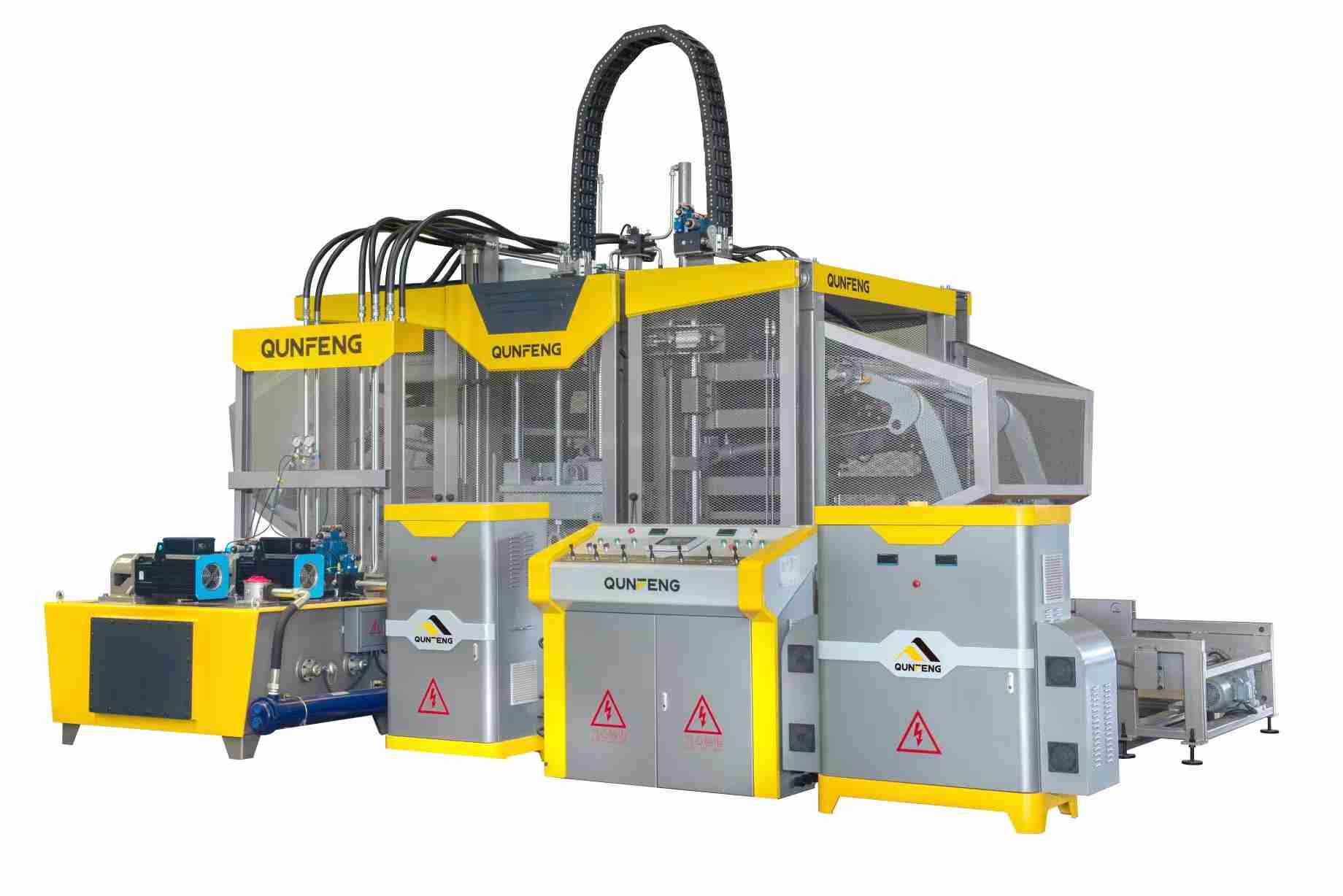
QUNFENG's third-generation servo system shortens response time to milliseconds. Independent tests show energy savings of 12-15% and a vibration start-up rate increase of more than 20% compared to the previous generation.
This system uses two servo motors to achieve high frequency and excellent synchronization. It delivers approximately 20% higher output through electro-hydraulic integration and reduces noise by about 10% via suspension-type vibration.

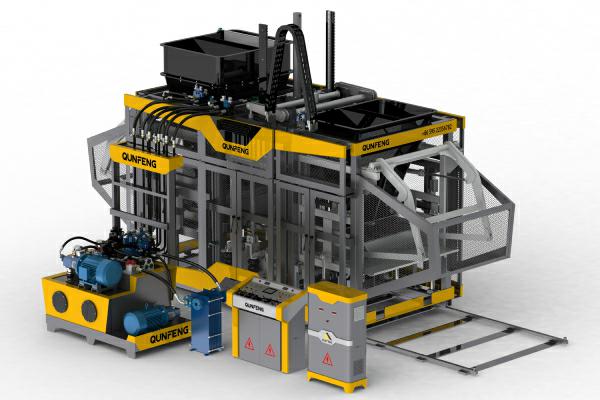
Unlike standard table vibration machines, this design produces denser blocks with less noise. It is especially suitable for hollow blocks and pavers where uniform compaction matters most.
Core hardware uses Siemens PLC and sensors from German Turck. The system includes full-range fault alarms and automatic diagnosis, shortening troubleshooting time by roughly 30%. Part of the cloud infrastructure, cloud monitoring enables real time tracking of data.
Using linear displacement sensors combined with closed loop control gives interference-cancelling, pressure and positioning controls and provides real-time control to minimize material waste.
The hydraulic system regulates itself; the output of the hydraulic system is adjusted to match the existing working condition. This prevents energy wastage and increases the durability of the pump.
Airbag clamping accelerates mold changes and lowers noise. Shock pads made from imported Michelin raw rubber improve damping and reduce vibration transmission to the frame.
These features are not marketing hype. They have been validated in QUNFENG's own factory tests and by third-party inspections for CE and ISO compliance.
The table below lists eight models frequently selected by international buyers. Each model serves a different investment level and production need.
Model | Key Specification | Practical Advantage |
QF400 | Pressure 8 MPa, cycle 12-25 s, 21.45 kW | Economy model with 360° rotary feeder; short payback period for small startups. |
QF800 | Pressure 21 MPa, cycle 11-22 s, 44.8 kW | Dual-cylinder synchronized demolding; good cost-performance for small to medium businesses. |
QS700 | Vibration motor, swing feeding | Simple and compact; fits basic production lines with fast installation. |
QS1000-H | Pressure 21 MPa, block height 35-500 mm | Two-axis servo plus three-pump two-motor hydraulic control; wide brick type compatibility. |
QS1300-H | Pressure 21 MPa, 87.4 kW | Best-selling model; servo system reduces labor cost by about 15% and increases output by roughly 20%. |
QM1200 | Cycle 10-22 s, U-shaped vibration | Patented non-table vibration and anti-mix color feeding system; ideal for high-capacity plants. |
QP600 | Main pressure 6000 KN, 20-25 s cycle | Static hydraulic press for dry PC terrazzo tiles and pavers; pallet-free forming saves pallet costs. |
QP900 | Max pressure 9000 KN, 15-17 s cycle | Board-free automatic press forming; bidirectional pressing delivers high density and uniform quality. |

QUNFENG has supplied equipment to more than 120 countries over the past 20 years. In the Middle East, a QS1300 automatic block production line has operated continuously for 800 hours in ambient temperatures above 40°C with no major component failure.
Customers frequently mention three strengths: adaptability to local raw materials (fly ash, slag, recycled aggregates), customized process solutions, and responsive after-sales support. At the 2026 World of Concrete exhibition in Las Vegas, QUNFENG's millisecond-level synchronization technology attracted multiple international orders from buyers who had previously worked with European suppliers.
Choosing the right Block Production Machine Manufacturer is a strategic decision with direct financial impact. In 2023, purchasing decisions involve certifications, the use of energy-efficient hydraulics, modularized automation, and reliability during operation. With the help of technologies like servo synchronization and closed-loop control, QUNFENG has been able to take on some of the complaints. This sample product provides clients the ideal initial option. Utilizing their budgets and capacity needs, QUNFENG developed a product for the 2026 market which is data steered and leveraged to decrease product downtime and overall ownership costs.
Q: How long does it take to get a block production machine?
A: Usually 30 to 60 days depending on model and customization. QUNFENG will specify a lead time once the order is confirmed.
Q: Will you assist us with the equipment installation and provide staff training?
A: QUNFENG sends engineers for installation and commissioning and to provide training for the staff. We provide training and diagnostics support online.
Q: How can we get assurance spare parts will be available?
A: QUNFENG stocks most parts and can send them in less than 3 days in most cases. A recommended parts list is included with each machine.
Q: Is the equipment adaptable to the use of other production materials, e.g. ash or slag?
A: Yes, our equipment does not compromise the strength of blocks when using local materials such as ash, slag, reclaimed aggregates and others.
Q: What tests and certifications do your machines have?
A: All our machines have independent tests to ISO 9001 and CE certifications. These can be shared to interested parties.