Author: Site Editor Publish Time: 2026-05-11 Origin: Site
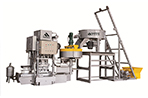
The concrete block machine is the most important piece of equipment in modern masonry production. It takes raw materials, namely, cement, aggregates, and water, and produces masonry units in the form of blocks, pavers, and curbstones. For large-scale construction to be completed in a timely manner, a concrete block machine is a necessity. However, concrete block machines are not equally designe
The purpose of this article is to provide a complete overview of concrete block machines, state contemporary market challenges, analyze concrete block machine manufacturers, and show where QUNFENG, through the example of the QS2000, has the best design options that focus on the pragmatic needs of the market.
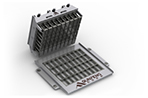
Concrete block machines may use pressure, vibration, and, in some cases, hydraulic force to compact a raw mix into concrete blocks. The molds used in the machines shape the blocks.
The process is as follows:
1. The aggregates and cement are put into the mold cavities.
2. While the pressing force is applied, vibration is introduced.
3. Ejection and curing: the formed blocks are pushed onto a curing racking system and a steel pallet.
Block production machines come in a much smaller scale manual variant, producing 10 to 20 blocks a cycle, to fully automatic production lines that have a cycle time of 15 seconds or less. It is much more common for medium to large sized projects to utilize a semi-automatic or fully automatic block production machine in order to achieve a consistent quality and to reduce the cost of labor.
There are three challenges that all manufacturers and purchasers of concrete block machines share:
1. Energy costs
Traditional hydraulic machines consume high power in their idles and pressing phases, and without some kind of energy recovery, the electricity costs are a large cut into the margins.
2. Workforce shortages
With fewer skilled operators, machines need to be more easily controlled and have remote monitoring and diagnosing capabilities as well as remote injection molding and maintenance capabilities.
3. Preference for Variety
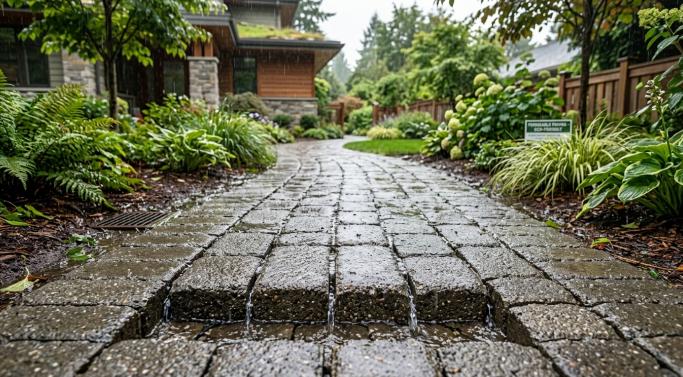
Customers prefer offering variety. For example, in addition to standard hollow blocks, customers also want colored pavers, grass blocks, and blocks with heights of up to 500 mm. This requires a rapid and precise change of molds and recipes.
These problems explain the trends in the 2026 ranking regarding the top and most reliable concrete block machine manufacturers who include modular design, energy efficiency, and automation.
These are some of the leading manufacturers who appear in the frequent international buyer and industry recommendations. This is a neutral, alphabetical list of top manufacturers of concrete block machines:
• Besser: long history of solid machines and robust manufacturing, especially of large hollow block. Higher price point.
• United States: reliable, multi-layer block machines with reliable support for part needs for all North America.
• QGM: a huge range of automated/semi-automated lines. Dominant player in Africa and SE Asia.
• QUNFENG: Automated modular designs with servos, cloud based diagnostics with energy feedback. QS2000 model is usually seen in 2026 buyers as the best balance of cost and features.
• Zenith (Germany): precision engineering, high-frequency vibration, excellent for pavers. Premium price.
When evaluating quality, experienced buyers look at:
• Cycle time stability (not just peak speed)
• Availability of local technical support
• Spare parts delivery time
• Real energy consumption data
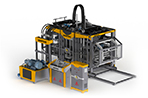
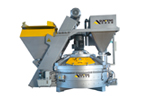
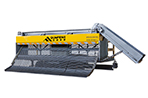
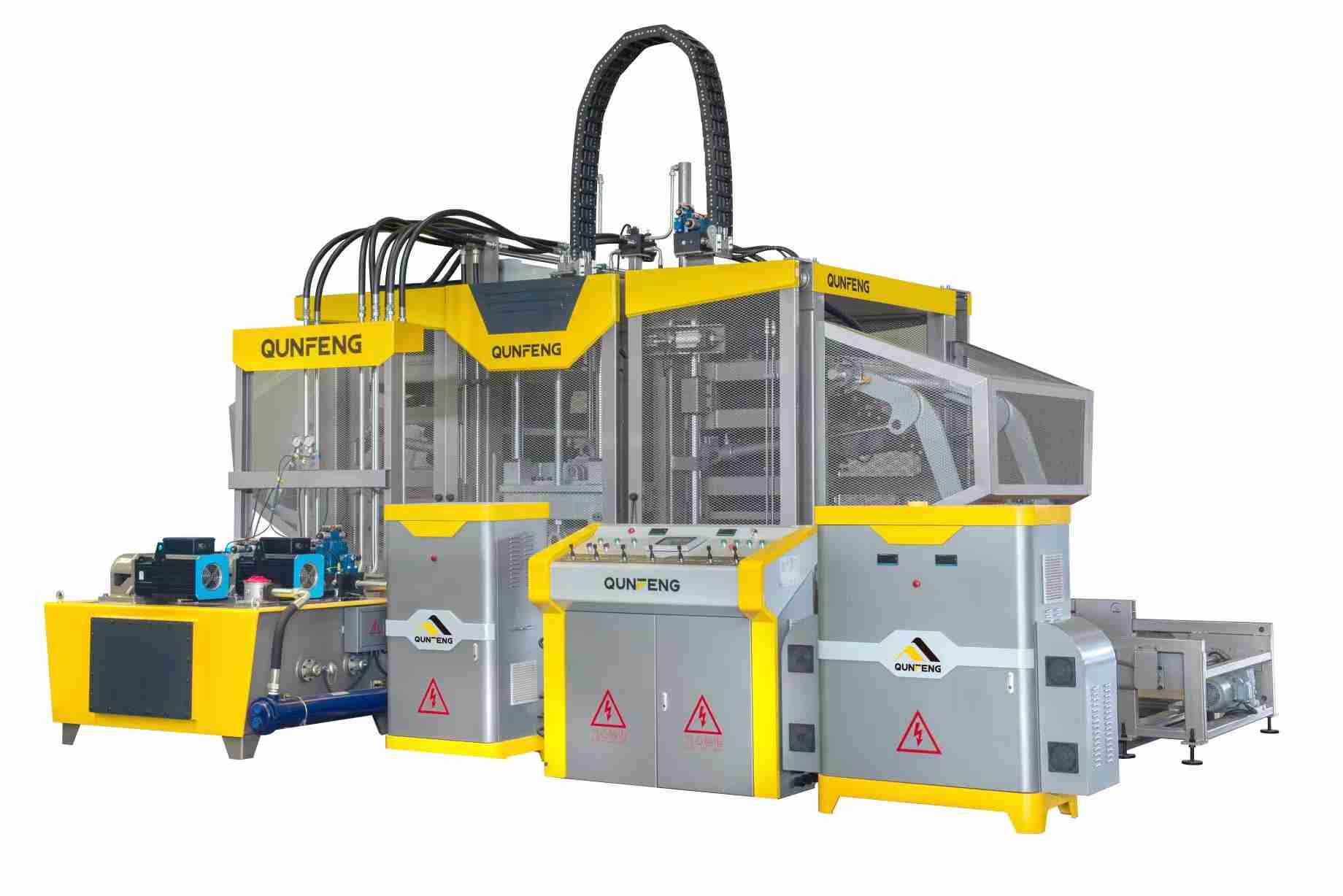
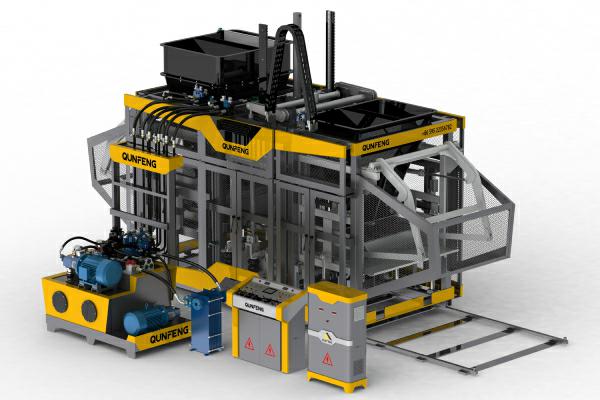
To understand how design evolves, it helps to look at one specific concrete block machine that follows current engineering trends. The QUNFENG QS2000 is a servo-driven, modular block machine built for medium-to-large producers. Below are the practical features that align with today's demands — without marketing exaggeration.
The QS2000 replaces old-fashioned hydraulic vibrators with high-dynamic servo motors. This creates moderate vibrations and a cycle time between 15 and 23 seconds.
Servo vibration is the next generation of vibrating systems. For the first time, operators get to control and set the system to the optimal level of vibration for each block type the machine produces (solid, hollow, or pavers).
The control system is founded on a standard Siemens PLC with modular expansions. An entire production line is not affected by the failure of a singular module, as only that section halts.
One thousand unique block designs can be stored and retrieved to eliminate setup errors. The system does this in real-time.
During the braking phase of servo motors, the QS2000 recycles energy back to the power supply. Independent tests show roughly 30% lower energy consumption than equivalent hydraulic machines at similar output levels.
For a plant running two shifts, this saving often covers one full-time worker's salary per year.
The machine uses imported Michelin rubber pads combined with airbag clamping to isolate mechanical vibration. This has two measurable benefits:
• Noise on the production floor is reduced by 10–15dB compared to rigid-mounted machines.
• Moulds last longer because they are not shaken beyond design limits.
Instead of simple remote monitoring, the QS2000's cloud system tracks vibration trends, oil temperature, and cycle times. When a parameter drifts (e.g., gradual pressure drop), the system sends a pre-failure alert.
Maintenance teams can check the machine from a phone or laptop, which is especially useful for sites with limited on-site engineers.
Many 2026 buyers want multi-colored pavers or “anti-mix” facing layers. The QS2000 includes a color feeding system that prevents pigment bleeding between layers.
With closed-loop hydraulic control and linear encoders, product height tolerance stays within +/- 0.5mm — comparable to European standards, but at a different price point.
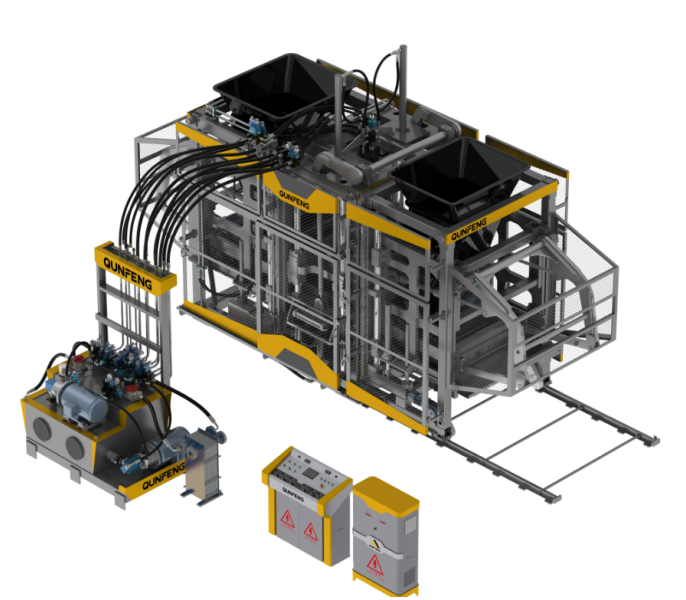
Concrete block machine owners increasingly prefer modular architecture over one-piece welded frames for three reasons:
• Easier repairs: You replace a vibration module or servo drive, not the whole machine.
• Scalability: A basic machine can later add automatic pallet stackers, color feeders, or curing systems without reprogramming everything.
• Lower downtime: Modular components can be diagnosed and swapped in hours, not days.
The QS2000's modular vibration unit and detachable hydraulic station follow this principle. It is not a “revolutionary” design, but a practical evolution of what industrial buyers requested over the past five years.
If you are sourcing equipment for a construction materials business, here is a simple checklist compiled from industry guidelines:
• Cycle time range: Ask for the full range (min to max), not just the best number.
• Power rating and real consumption data: request a meter reading from a similar installation.
• Spare parts availability: Confirm that critical parts (servo drivers, PLC modules, rubber pads) can be delivered within 7–14 days to your region.
• Software update policy: Can you receive recipe management and diagnostic updates without a paid subscription?
• Manufacturer/Operator Training: Does the manufacturer offer on-site/in-person or virtual training for your operators?
There are no promises of new technologies or fanciful speeds for the 2026 concrete block machine market. It is about steady improvements in energy efficiency, modular repairability, and intelligent monitoring that reduces unplanned stops. Established brands like Besser and Columbia continue to serve heavy industries well, while suppliers such as QUNFENG (with models like the QS2000) bring accessible servo and cloud technologies to mid-sized producers.
When you evaluate a concrete block machine, look past marketing language. Focus on cycle stability, energy feedback, modular architecture, and local support availability. Those factors will determine your real production cost per block — and that is the number that truly matters.
Q1: What is the lifespan of a concrete block machine like the QS2000?
A: With good maintenance and use, including lubrication and replacement of the vibration pads and care of the servos, the modular machine should give good service for 10 years or even longer. The major electronic and hydraulic components are designed for replacement in the field.
Q2: How much space is required for a fully automatic concrete block machine line?
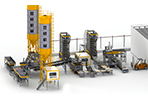
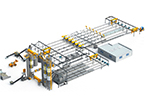
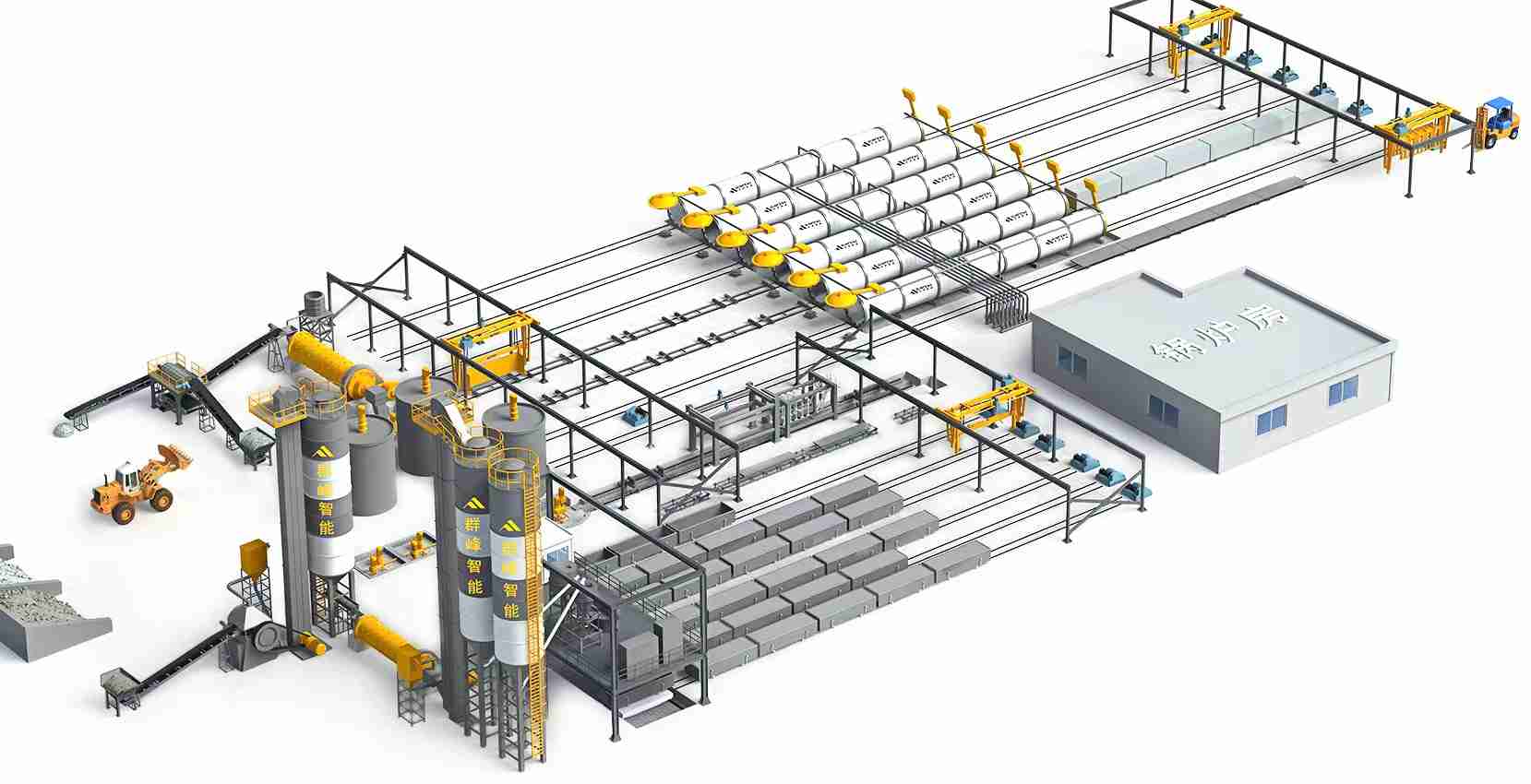
A: For a medium-output line, (including the block machine, pallet feeder, mixer, and an area for a curing rack) you should plan for 500–800 m². The QS2000 has a small footprint, just under 8m × 4m, not including conveyors and auxiliary systems.
Q3: Can you make blocks of various sizes and shapes on a single concrete block machine?
A: Absolutely. Nearly all the molding machines today are equipped with changeable molds. The QS2000 has the capacity to produce blocks with heights between 45mm and 500mm. Mould changes take 10–20 minutes, and the Siemens PLC can hold hundreds of block recipes for easy selection.
Q4: Is it hard for a person to learn how to operate a servo driven block machine?
A: Not for anyone with previous experience. The system has a touch and guide user interface. QUNFENG does on-site (2–3 days) and a remote (video) training. Basic operations can be learned in one shift, while more complex operations and diagnostics take more time to learn.
Q5: What is the energy savings compared to a conventional hydraulic block machine?
A: Independent testing shows that the QS2000 saves between 25 and 30% on electricity required per ton of blocks produced, when compared to a machine with a hydraulic system that has a fixed (and therefore, limited) speed that operates on the same production schedule.