Author: Site Editor Publish Time: 2026-07-31 Origin: Site
Stronger fly ash bricks cannot be guaranteed with the raising of hydraulic pressure alone. A factory can raise forming pressure to produce smoother surfaces while still holding inner voids, chipping edges, inconsistent compressive strength, and layer separation.

Varied moisture content, poor particle grading, uneven filling of the mold, improper vibration settings, and inadequate curing lead to many quality issues. The evaluation of a Fly Ash Brick Production Machine must be done in conjunction with the complete preparation, forming, handling, and curing of the material.
The degree of packing of solid particles in a given volume defines Density, and is expressed as:
Dry density = Oven-dry mass ÷ Brick volume
The general rule is that minimum density corresponds to maximum porosity, although it must be recognized that density is not the sole determinant of strength. Other factors include:
• Fineness and chemical activity of fly ash
• Content of cement, lime, gypsum and other binders
• Grading of aggregates
• Water/binder ratio
• Forming and demolding stability
• Curing conditions (temperature, humidity, time)
Excessive compaction can lead to layering and poor demolding. Buyers should assess both density and strength distribution rather than pursuing the highest possible pressure.
Average compressive strength can hide unstable production. Quality evaluation should include:
• Minimum individual strength
• Standard deviation
• Coefficient of variation
• Seven-day and 28-day strength
• Batch-to-batch deviation
• Edge and corner integrity
The coefficient of variation is calculated as:
Coefficient of variation = Standard deviation ÷ Average strength × 100%
A lower value normally indicates more consistent batching, forming, and curing.
A Fly Ash Brick Production Machine cannot compensate for unsuitable or highly unstable materials.
Important variables include:
• Particle-size distribution
• Fineness
• Moisture content
• Loss on ignition
• Unburned carbon
• Reactive glass phase
• Chemical composition
• Variation between deliveries
High unburned-carbon content may affect water demand and binder interaction. Excessive fine material can improve void filling but also increase moisture demand and reduce feeding flow.
A well-graded mixture uses fine particles to fill spaces between larger particles. Poor grading can produce either excessive voids or a sticky mixture that is difficult to distribute.
For semi-dry forming, the optimum moisture level should be established through production trials. Operators should check whether the mixture:
• Forms a stable lump when compressed
• Breaks apart without smearing
• Fills corners and narrow mold sections
• Releases without sticking
• Maintains shape after demolding
Even a small moisture shift can change feeding behavior and green-brick strength.

Forming Technology | Operating Principle | Main Advantage | Limitation |
Mechanical vibration | Mechanical excitation with mold compression | Relatively simple structure | Limited parameter flexibility |
Vibration-hydraulic | Vibration rearranges particles before hydraulic consolidation | Suitable for blocks, bricks, and pavers | Requires coordinated pressure and vibration |
Servo vibration-hydraulic | Servo-controlled frequency, response, and forming stages | High parameter repeatability | Higher control and maintenance requirements |
Static high-pressure pressing | High static pressure without intensive vibration | Suitable for certain solid products | Less flexible for complex or hollow products |
No single technology is suitable for every plant. Selection should depend on product geometry, raw-material grading, target density, production volume, mold-change frequency, power availability, and local maintenance capability.
In the process of forming, vibration is an important element as it decreases the internal friction of particles, allowing them to:
• Move and fill the mold cavity
• Minimize localized voids
• Release trapped air
• Spread and fill the mold cavity
• Create a uniform layer prior to pressing
In Fly Ash Brick Production Machines, some fixed frequency vibrations can work for individual products, but it is better to use a wider adjustable range for some flexibility to deal with various materials and dimensions of bricks.

Hydraulic pressure limits product height, increases green strength, and improves edge definition. However, rated system pressure is not the same as the pressure acting on the brick surface.
Actual forming force is influenced by:
• Cylinder effective area
• Press-head area
• Number of mold cavities
• Hydraulic losses
• Pressing stroke
• Material resistance
• Pressure-holding time
A controlled forming sequence normally includes feeding, pre-vibration, press-head descent, main vibration, hydraulic compression, short holding, and synchronized demolding.
Two vibration-hydraulic machines may have similar rated capacities but very different control depths.
Control Area | Basic Machine | Advanced Machine | Production Effect |
Vibration | Fixed setting | Adjustable frequency and stages | Better density consistency |
Hydraulic control | Basic pressure limit | Pressure and sequence monitoring | Lower height variation |
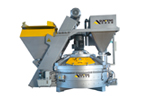
Feeding | Simple reciprocating feeder | Rotary rake or multi-stage feeding | More uniform mold filling |
Press head | Basic guidance | Multi-cylinder synchronized guidance | More even compression |
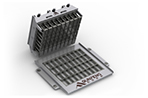
Mold system | Standard machining | Heat-treated plates and hardened guides | Longer dimensional stability |
Data management | Output counter | Pressure, downtime, and alarm records | Improved traceability |
Parameter | Technical Reference | Procurement Importance |
Vibration frequency | Adjustable range under load | Affects particle movement |
Rated pressure | System pressure and force transmission | Affects forming repeatability |
Cycle time | Must match the actual product | Determines realistic capacity |
Product height range | Minimum and maximum forming height | Indicates product flexibility |
Pallet size | Effective molding area | Determines pieces per cycle |
Feeding method | Feeder path and distribution structure | Affects brick-weight variation |
Mold-change time | Measured production stoppage | Important for multi-product plants |
Installed power | Main machine and complete line separately | Supports energy-cost calculation |
Rated capacity should be converted into qualified production:
Qualified output = Pieces per pallet × Actual cycles per hour × Utilization × Pass rate
For example, a Fly Ash Brick Production Machine producing 70 bricks per pallet at a 15-second cycle has a theoretical output of:
• 3,600 ÷ 15 = 240 cycles per hour
• 240 × 70 = 16,800 bricks per hour
• At 85% utilization and a 97% pass rate:
• 16,800 × 0.85 × 0.97 ≈ 13,852 qualified bricks per hour
High-strength products may require longer feeding, vibration, or holding time. The shortest cycle is therefore not always the most economical setting.
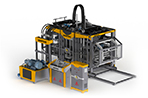
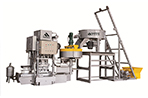
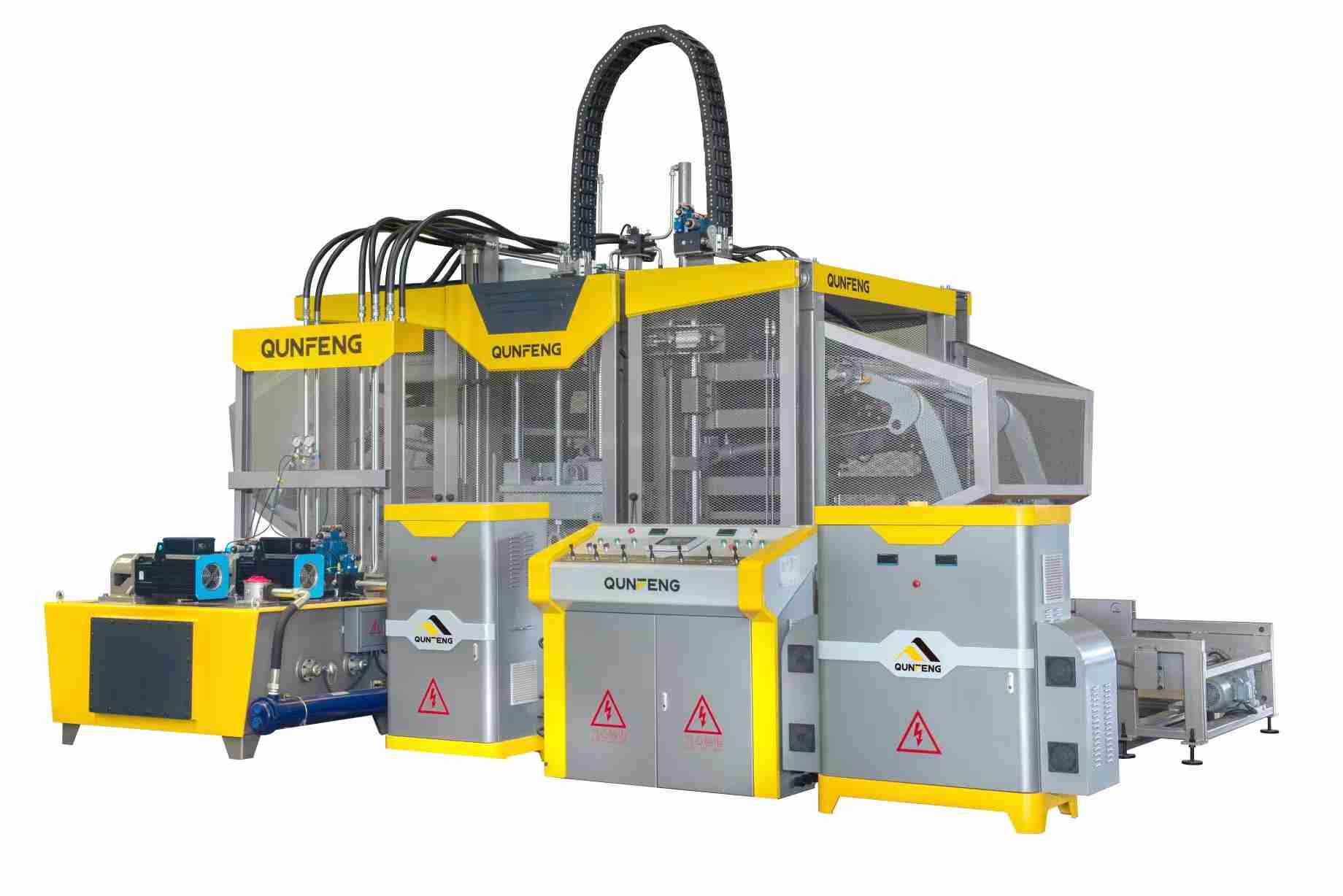
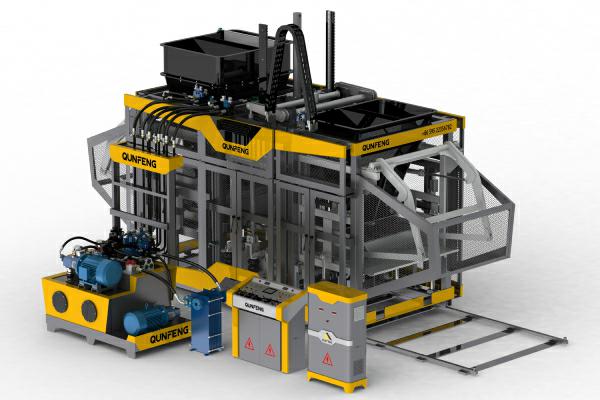
Qunfeng's QS1500 can be used as a technical reference for comparing servo-based forming systems. Manufacturer-provided specifications include:
• Four-axis servo vibration
• Frequency range of 0–75 Hz
• Rated hydraulic pressure of 21 MPa
• Forming a cycle of 11–19 seconds
• Product height range of 35–300 mm
• Pallet size of 1,400 × 1,000 mm
• Main-machine installed power of 87.1 kW
The adjustable vibration range supports parameter matching for different materials and product heights. Its 360-degree rotary rake feeder is intended to improve multi-cavity filling, while the dual-cylinder press-head structure supports synchronized compression. Heat-treated mold plates, strong guide pillars, airbag clamping, and vibration isolation help keep the dimensions stable and make it easier to change molds.
High-density and high-strength bricks result from coordinated raw-material preparation, moisture control, feeding, vibration, pressure, demolding, and curing. Buyers should compare different options side by side to choose a forming method and look at how well each option controls depth, mold accuracy, feeding consistency, and traceability.
Are you considering the establishment of a Fly Ash Brick Production Machine project? Send Qunfeng your fly ash data, binder system, product dimensions, desired compressive strength, curing method, and expected output. Following this, the trials for production, along with the variations in parameters, will allow the proposal of technically matched equipment.
Q1. What materials can be processed using a Qunfeng Fly Ash Brick Production Machine?
A Qunfeng Fly Ash Brick Production Machine may be configured for a variety of combinations including fly ash, cement, sand, stone powder, slag, tailings, and some recycled aggregates. The mixtures should be determined by testing the materials locally.
Q2. How does Qunfeng enhance the density of fly ash bricks?
Qunfeng employs controlled material feeding, servo vibration, and hydraulic compression with a system for synchronized demolding. This technology helps to evenly distribute the material and eliminate internal voids to enhance density.
Q3. Do stronger bricks require higher hydraulic pressure?
Not necessarily. Hydraulic pressure is one of many variables that affect brick strength. Other variables include the moisture content, particle grading, binder activity, vibration, uniformity of the feeding, precision of the mold, and the conditions of curing.
Q4. What is the vibration frequency range of the Qunfeng QS1500?
The Qunfeng QS1500 is equipped with a four-axis servo vibration system. The specified frequency range is 0–75 Hz. Actual settings should be determined based on the material, the height of the brick, the structure of the mold, and the density of the brick.
Q5. What is the maximum height of products that can be formed using the Qunfeng QS1500?
The maximum height that can be formed using the Qunfeng QS1500 is in the range of 35–300 mm. Thus, thin paving units, standard bricks, concrete blocks, and curbstones can be formed, along with other concrete products using appropriate molds.