Author: Site Editor Publish Time: 2026-05-13 Origin: Site
When making decisions on the Paver Block Making Machine, knowledgeable buyers agree that uniform block density is an indicator of the product's strength and weather resistance. In 2026, when construction waste recycling and low-carbon production become normative regulations across Europe, the Middle East, and Southeast Asia, further precision in vibration frequency control will be a significant differentiator of the most advanced competitors
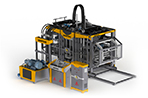
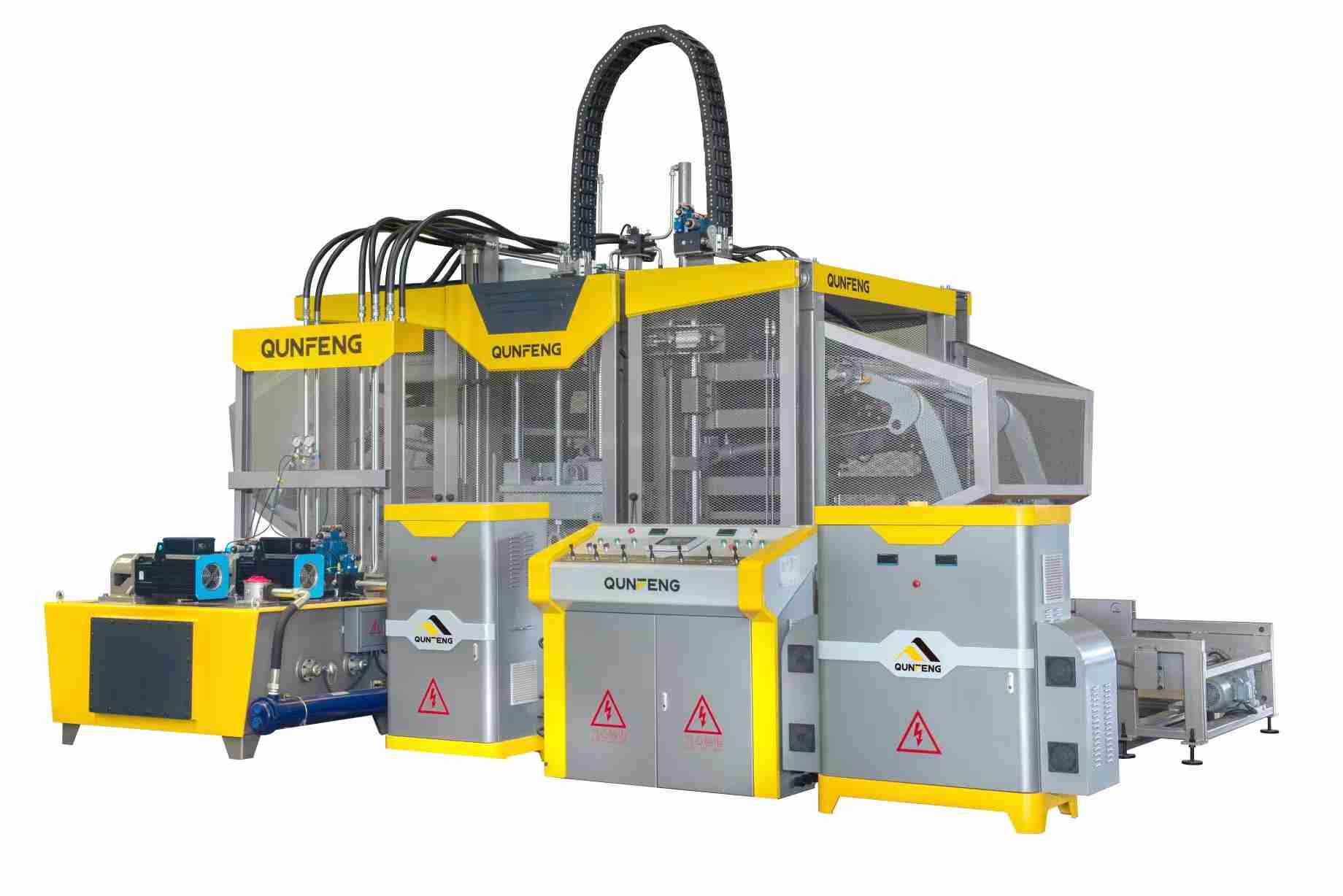
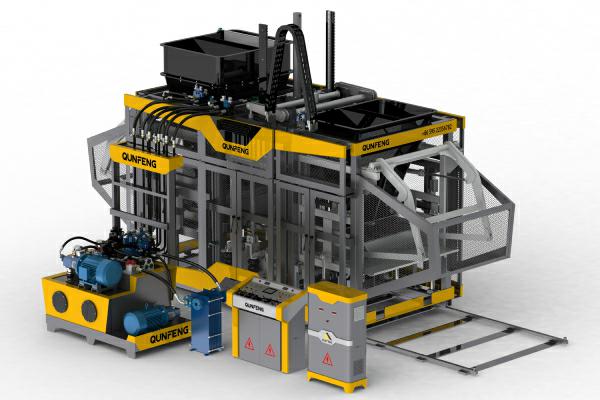
QUNFENG, in over thirty years of equipment design and in 120 countries, has incorporated variable frequency vibration (VFV) into the QS700 automatic block machine, to provide the first serious data-based answer to the industry's greatest obstacle to quality.
Blocks that are not properly compacted will fail loads, absorb water, and not comply with code, resulting in rejected batches and lost business. Vibration systems with fixed frequencies (generally at 50 Hz) behave the same way, irrespective of the material, moisture, and the type of the aggregate. This standardized compaction results in:
• Cracking: mixes with high contents of fly ash or slag can result in high air voids.
• Hidden voids: The air trapped inside the block reduces load-bearing capacity by 15%–25% and is often undetectable until field failure.
• Increased cement waste: More cement to make up for low density increases costs for materials.
A Paver Block Making Machine with variable frequency control solves these problems by matching vibration characteristics to the raw material.
The QS700 features a vertical vibration system utilizing a variable frequency drive (VFD) capable of adjusting both frequency (0-75 Hz) and amplitude separately. Most motors run at a constant speed. With a VFD, the QS700 can provide customized vibration levels for the product being processed, as the VFD allows for distinct vibration conditions.
Key operating principle: Lower frequencies (20–35 Hz) with higher amplitude move coarse aggregates into place. Higher frequencies (50–75 Hz) with lower amplitude settle fine particles and expel trapped air.
This technical capability translates into measurable density improvements:
• Density variance reduced to under 2% across a single pallet, compared to 5–8% with fixed-frequency systems.
• Green strength (immediately after molding) increases by 12–18%, allowing faster demolding and pallet turnover.
• Curing time shortened by one full day for standard pavers, cutting yard space requirements.
One of the most practical benefits of a variable frequency Paver Block Making Machine is its adaptability to low-cost, recycled feedstocks. As of 2026, there are buyers who would spend more on machines designed to process construction and demolition waste, slag, and fly ash.
For materials that are more than 8% moisture content and are wet and sticky:
• To mitigate adhesion of materials to the walls of the mold, short bursts of high-frequency vibrations of approximately 70 Hz for a duration of 2-3 seconds are useful.
• This results in cycle times that are approximately 1.5 seconds shorter than those achieved with a constant low-frequency operation.
• For dry and sticky (moisture between 3% to 6%) granular mixes:
• A gradual ramping of the compaction frequency from 30 Hz to 65 Hz is effective, causing minimal tearing on the surface.
• Targeting the final density is achieved with 7% less energy causing vibration, which reduces the wear on the mold boxes.
For multi-layer pavers, which have a color top and base material:
• A low-frequency compaction of 25 Hz is effective for the color base of the layers, and a high-frequency compaction of 70 Hz is required to finish the layer compaction, thus eliminating the intermix of the base with the top layer.
• This configuration also prevents the migration of the color top layer into the base layer.
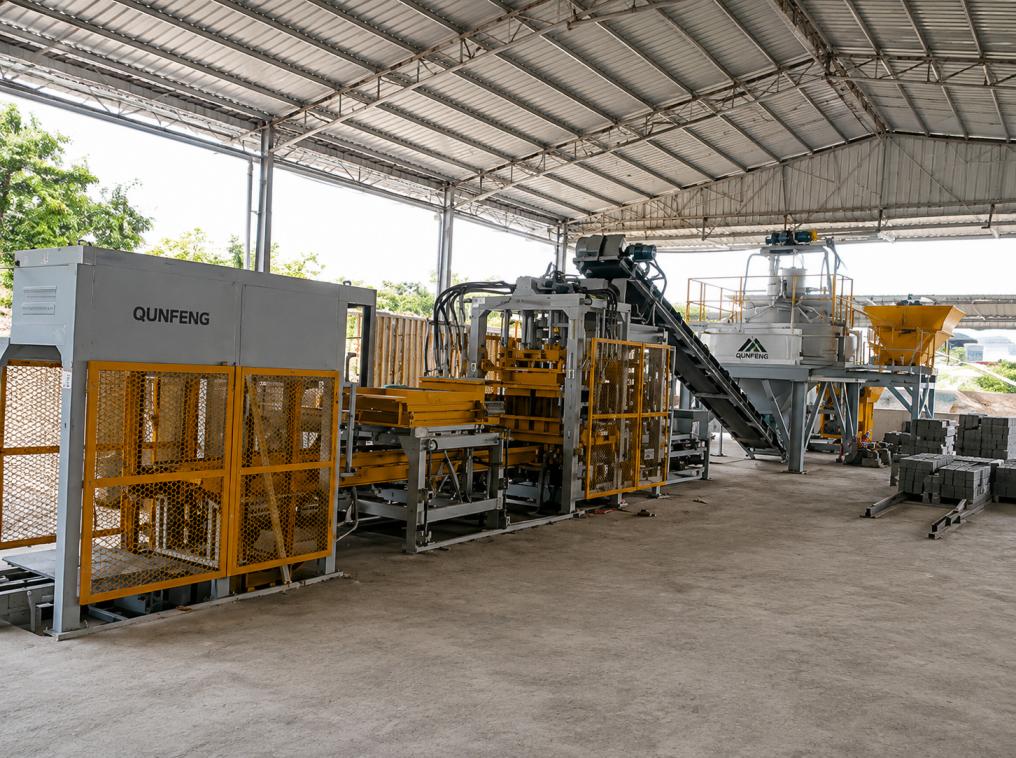
From the information we have, QUNFENG, along with other similar Chinese manufacturers, is ranked the highest among the listed Chinese manufacturers, especially for serving the low- to medium-cost segments of the market. From the 2025-2026 surveys, it was reported that machines with servos and variable frequency drives from these manufacturers held approximately 38% of the new machine offerings in Africa and the Middle East, and 22% in Eastern Europe.
Among China's top-tier producers, QUNFENG is recognized for:
• Over 300 national patents in hydraulic and vibration control systems.
• ISO 9001 and CE certifications meeting European safety and performance standards.
• More than 10,000 active installations across 120 countries, with particular strength in block plants processing recycled materials.
For procurement managers conducting a Paver Block Making Machine supplier comparison, QUNFENG's QS700 occupies the performance segment directly below fully automated servo lines but above entry-level hydraulic machines—offering variable frequency vibration as standard rather than an expensive upgrade.

Three market shifts are pushing variable frequency vibration from a “nice-to-have” into a baseline requirement for serious paver producers:
• Energy cost volatility: VFV systems consume 18–25% less electricity per block than fixed-frequency alternatives because they only apply full power during compaction peaks, not continuously.
• Raw material diversification: As governments phase out river sand mining and promote recycled aggregates, plants need machines that adapt to changing material behavior daily.
• New testing protocols mean core density testing of randomly selected samples will be required for all municipal projects. Fixed frequency machines typically will not pass this testing. However, VFVs typically will.
When reviewing quotations for the supply of Paver Block Making Machines for delivery in 2026, pay attention to the following checklist items
• Verify the frequency range: Most machines offer ranges of 0–50 Hz or 30–60 Hz. The range for the QS700 which is 0–75 Hz is therefore better. Verify with a vibration curve chart.
• Verify presence of programmable memory: Machines with the capability to memory recall up to 20 product types will have significant setup time reduced. QS700's Siemens PLC supports 99 recipes.
• Ask about amplitude control: Frequency changes without amplitude control are half a solution. The QS700 links both parameters via a single interface.
• Request a density test report: Reputable manufacturers will provide lab results comparing their VFV system against a standard 50 Hz machine using the same mix design.
Variable frequency vibrating Paver Block Making Machines are proven to save money on materials and energy and to help you pass stringent inspections. With the QS700, medium-sized producers now have access to intelligent vibration control that is affordable, reliable, and easy to manage.
By 2026, those who purchase machines that allow for flexible frequency and greater density of production will leave their competition who are still relying on hydraulic systems in the dust. For a density demonstration using your raw materials, or for more technical specifications, reach out to QUNFENG.
Q: What is variable frequency vibration in a Paver Block Making Machine?
A: The ability to adjust the vibration frequency between the range of 0–75 Hz allows the machine to generate block density that is more optimal and more consistent than any fixed frequency system.
Q: Does variable frequency vibration result in higher energy consumption?
A: No. It decreases electrical consumption by 18–25% since power consumption is only needed during critical compaction as required by the system, unlike the conventional systems where power is always used.
Q: Is the QS700 capable of utilizing fly ash and slag?
A: Yes. It is because of the behavior of the material under compaction that the system can achieve a consistent density level even when a large amount of construction waste and/or industrial byproducts mixes are used.
Q: Is the QS700 made for small or medium block plants?
A: Yes. It is intended for medium production scale and thus achieves the best combination of advanced vibration technology and the initial investment.
Q: How can I obtain a density test report for a special type of raw materials?
A: Reach out to QUNFENG or contact the local distributor to set up a local demonstration with your local choice of aggregates and preferred mix design.