Author: Site Editor Publish Time: 2026-06-25 Origin: Site
Paver and block manufacturers achieve consistent product density which impacts quality. Paving block machines that utilize vertical vibration technology have systematic solutions to paver density and compacting problems, which are the most common issues in most vibration systems. As the automatic block making machines industry progresses steadily and the industry value potentially going from $1.61 billion in 2025 to $1.74 billion in 2026, the technology that an organization implements in their production systems will likely impact their business performance even more.

In paving block machines, the core function of any vibration system is to aid the concrete mix in eliminating air voids and allowing the mix to achieve a denser state. The shape and size of the mix's final state are determined by the mold. Vibration energy is often applied through the base of the mold and this approach leaves large areas of the mold unvibrated and the mix undensified.
Compared to conventional systems, vertical vibration systems achieve better particl e settlement in their molds. The directed vibration, unlike the pallet base approach, allows for even settlement of the concrete mix through the entire height of the mold. The result is a consistently higher density profile across every block produced.
Aspect | Table Vibration (Conventional) | Vertical Vibration |
Energy transmission path | Through pallet → mold bottom → mix | Directly through mold box, in line with gravity |
Density variation per pallet | 5–8% (typical) | <2% (achievable with modern systems) |
Green strength at demold | Lower – requires longer curing before handling | 12–18% higher – enables earlier pallet turnover |
Curing time (standard pavers) | 3–4 days (yard-dependent) | Can be reduced by up to 1 full day |
Mold wear & maintenance | Higher friction; shorter mold life | Reduced friction; extended mold service life |
Vertical vibration technology has multiple improvements over classical systems in paving block machines, including:
• Minimal density variation: As stated, variation in vertical vibration systems is maintained close to a 2% mean. Thus, the load bearing strength becomes predictable, and the number of rejected blocks is greatly reduced.
• Greater green strength: Vertical vibration systems provide an increase in green strength of 12–18%, enabling faster demolding and stacking of blocks. This increase helps improve the systems overall productivity during the day.
• Shorter curing times: Because of the faster setting times, the cash flow is drastically improved due to the freed yard space and the decreased work-in-progress inventory.
• Reduced friction results in increased mold life: With the reduced friction between the forming shoes and the surfaces of the molds, the cost of replacements is reduced over the life of the system.
Vertical vibration is even more effective when used in conjunction with the variable frequency drive (VFD) control. Paving block machines that have the capability of independent control of both frequency and amplitude of the vertical vibration are able to meet this requirement, especially in cases of variable quality of the raw materials.
Optimal raw material results manifest with a tailored application of vibration parameters.
Material Type | Recommended Frequency Range | Amplitude Setting | Effect |
Coarse, high moisture aggregates (>8%) | Low, 20 – 35 Hz | High | Positioning of large aggregates |
Fine aggregate, dry mixes | High, 50 – 75 Hz | Low | Small aggregate consolidation and air removal |
Recycled aggregates (uneven grading) | Adaptive, 40 – 60 Hz | Medium | Compaction of uneven gradings |
Multi-layer pavers (color+base) | Bursting, ~70 Hz, 2-3 sec | Variable | Layer consolidation with integrity |
This level of control gives paving block machines the ability to provide consistent quality for a range of raw material input, particularly for recycled aggregates that may vary from batch to batch.

To illustrate the practical impact, the table below summarises typical performance improvements observed when upgrading from conventional to vertical-vibration-based systems in medium-scale production environments.
Performance Indicator | Conventional System | Vertical-Vibration System | Potential Gain |
Average cycle time (per pallet) | 15–20 sec | 12–18 sec | 10–15% faster |
Electricity cost per thousand blocks | Baseline (100%) | 80–85% | 15–20% energy saving |
Reject rate (density-related) | 3–5% | 1–2% | Lower waste and rework |
Daily output (8-hour shift) | Standard | +12–18% (with same labour) | Higher productivity without extra cost |
Raw material tolerance (moisture range) | ±2% | ±5% (with frequency tuning) | More flexibility in sourcing |
The construction industry's increasing emphasis on low-carbon solutions has made material flexibility a key selection criterion. Key trends include low-carbon concrete blocks and advanced sustainable production practices. A paving block machine that uses vertical vibration achieves good results with a wide range of materials, including the following:
• Construction and demolition waste: Vertical vibration accommodates the various particle sizes and compositions of the recycled aggregates.
• By-products from the industry: Due to the shape of their particles, slag and fly ash can be troublesome to compact, however adjusting a profile of vibration can help in the compaction.
• Multi-layer pavers: A system that applies a different vibration profile during the forming process can compact different layers of a multi-layer product and maintain the integrity of the layers.
Material Category | Compaction Challenge | Vertical‑Vibration Solution |
Crushed concrete (recycled) | High variability in particle size | Adaptive frequency compensates for gradation |
Fly ash (20–30% replacement) | Low initial plasticity | Higher frequency (60–75 Hz) improves settling |
Slag aggregate | Angular particles, poor flow | Lower frequency + high amplitude breaks arches |
Coloured top layer + base | Risk of colour mixing and density gradient | Short high‑frequency bursts stabilise interface |
This advanced vibration capability also allows producers to address emerging regulations and market demand for sustainable construction materials.
In the block making machinery industry, the level of technological capability has been the most important differentiator. To compete, market leaders are adopting advanced vibration technology, high-level control systems, and servo-driven hydraulics.
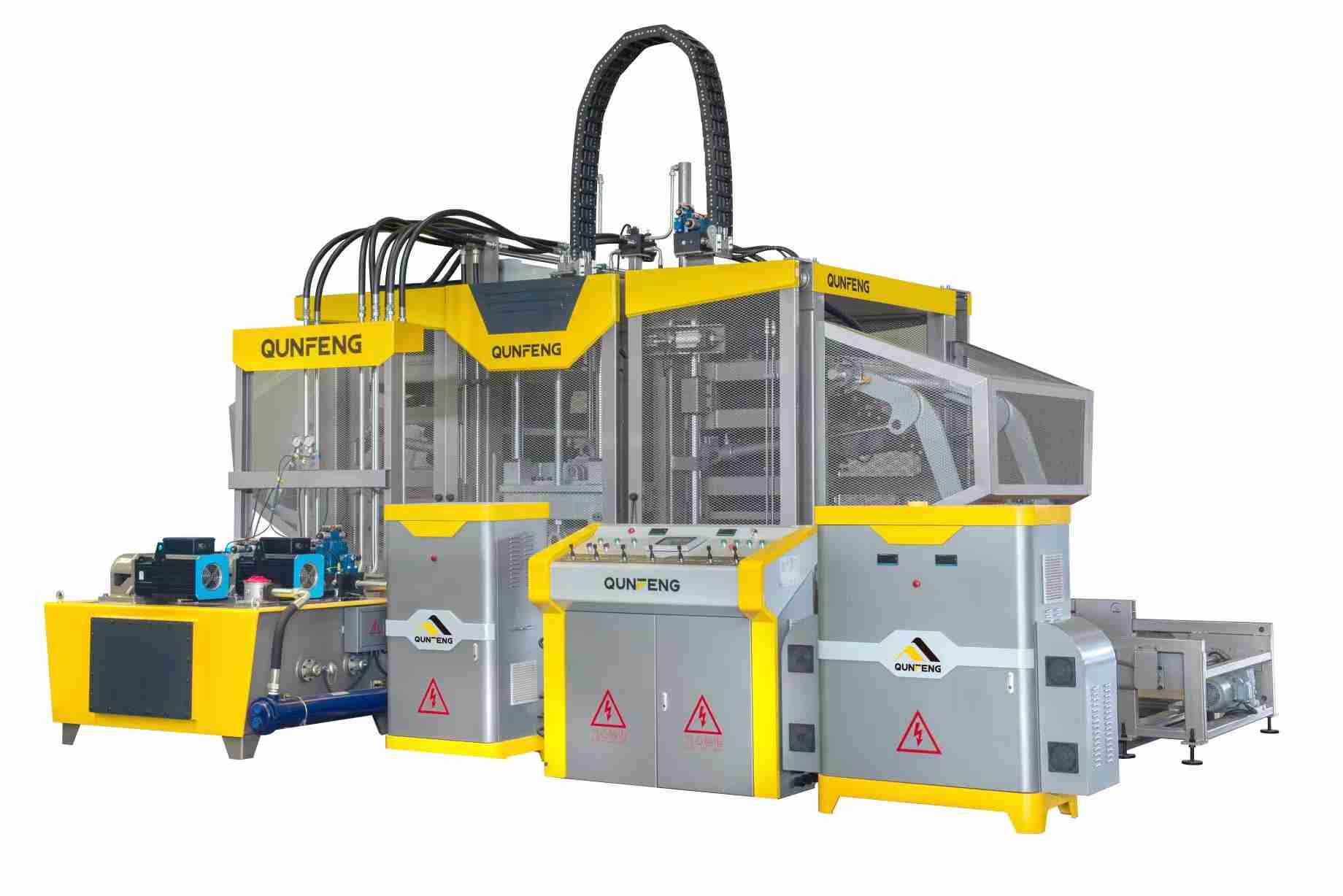
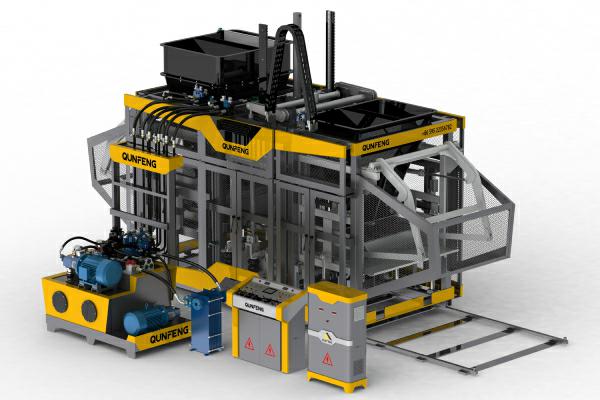
QUNFENG has a top global position in the industry due to their advanced technology and global strategy. The company operates a 215,000-square-metre intelligent manufacturing base and serves clients across more than 120 countries. Its self-developed third-generation servo vibrator, featuring variable frequency and amplitude control, delivers over 12% energy consumption reduction and more than 10% increase in excitation efficiency—with product height error controlled to within ±1 mm.
Industry rankings consistently place QUNFENG alongside established names such as Laeis GmbH (Germany), Besser Company (USA), and Rosacometta (Italy). This acknowledgment shows commitment to research and development in vibration system and control electronics.

Vibration technology will be a continuing focal point as the paving block machine market becomes increasingly automated and smart. Vibration technology will be a focal point because manufacturers want machines that achieve the same product density no matter what kind of raw material product is used. They want to achieve this in order to decrease waste and increase production output. Systems with Vertical vibration that has variable frequency control will achieve this goal.
This will sustain profitability and growth by allowing manufacturers to adjust raw materials while meeting product quality standards. This will assist adapting to the fluctuating availability of raw materials and sustain business growth.
Q: What does vertical vibration mean with a paving block machine?
A: Vertical vibration drives the compaction force in a linear up/down manner through the mold, resulting in the even settlement of particles and a higher density in the paving block.
Q: How does vertical vibration minimize reject rate?
A: Vertical vibration minimizes the density variation to below 2%, reducing the formation of weak spots and internal cavities, thus greatly reducing the number of blocks rejected in quality control.
Q: Is it possible to use a vertical-vibration machine with recycled aggregates?
A: Yes. As it is equipped with adjustable frequency control, it is highly likely to deal with various particle sizes and moisture contents, in addition to construction debris, slag, and fly ash.
Q: Does vertical vibration speed up curing?
A: Yes. Blocks tend to have better green strength, enabling early removal from the molds, and standard curing for pavers can even be shortened by one full day.
Q: What is the major difference between vertical and table vibration?
A: In table vibration, energy is transmitted through the pallet and often results in uneven density, whereas in vertical vibration, energy is transmitted directly through the mold, resulting in uniform compaction.